
Huntington Senior Rachel Huth Wins at LISEF
March 13, 2026
Huntington High School senior Rachel Huth emerged from a field of formidable competitors to win first place at the Long Island Science and Engineering Fair finals at the Crest Hollow Country Club in Woodbury on Thursday.
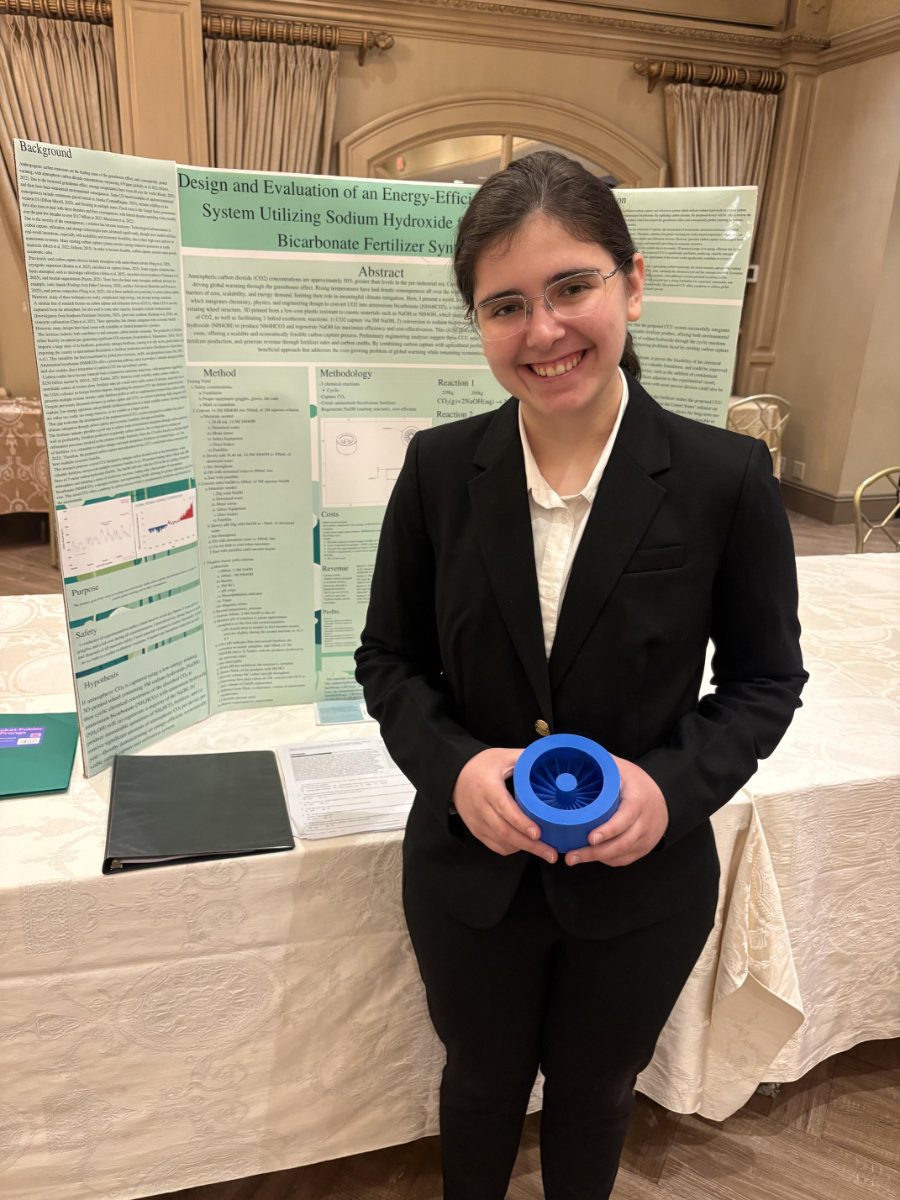
Ms. Huth claimed the Student Award for Geoscience Excellence presented by the Association for Women Geoscientists. Huntington science research teacher Lori Kenny accompanied Ms. Huth to the competion.
“Congratulations on winning the Student Award for Geoscience Excellence for your terrific research presentation this year,” wrote Julie Fosdick and Busayo Omisore of the Assn. for Women Geoscientists. “The AWG is a global organization devoted to enhancing the quality and level of participation of women in geosciences and to introduce young women to geoscience careers.”
“I’m happy to be representing Huntington at such a prestigious competition,” Ms. Huth said. “I am very passionate about the environment and I’m excited to continue perfecting my carbon capture device. I’m honored to have competed among the top young scientists of Long Island.”
The LISEF competition is structured into two rigorous rounds: a virtual first round where all participants present their work to professional judges, followed by an in-person second round for the top 25 percent of qualifiers. Students competed in over 20 categories—ranging from Biomedical Engineering to Environmental Sciences—vying for grand awards, special honors, and the opportunity to join the "Official Party" representing Long Island at the International ISEF finals in Phoenix, Arizona.
Abstract of Rachel Huth’s Research Project:
Atmospheric carbon dioxide (CO2) concentrations are approximately 50 percent greater than levels in the pre-industrial era. Carbon dioxide is the most prominent greenhouse gas, and is driving global warming through the greenhouse effect. Rising temperatures have had drastic consequences all over the world. Existing carbon capture devices have faced many barriers of cost, scalability, and energy demand, limiting their role in meaningful climate mitigation.
Here, I present a novel, low-energy carbon capture and utilization (CCU) system which integrates chemistry, physics, and engineering design to convert CO2 into ammonium bicarbonate (NH4HCO3), a valuable nitrogen fertilizer. This CCU system employs a rotating wheel structure, 3D printed from a low-cost plastic resistant to caustic materials such as NaOH or NH4OH, which maximizes air exposure and allows for optimal absorption of CO2, as well as facilitating 3 linked exothermic reactions: 1) CO2 capture via 5M NaOH, 2) conversion to sodium bicarbonate (NaHCO3), and 3) reaction with ammonium hydroxide (NH4OH) to produce NH4HCO3 and regenerate NaOH for maximum efficiency and cost-effectiveness.
This cyclic process minimizes input and associated difficulties and costs, offering a scalable and economically feasible carbon capture process. Preliminary engineering analyses suggest these CCU units can operate at low cost, provide domestic fertilizer production, and generate revenue through fertilizer sales and carbon credits.
By combining carbon capture with agricultural profitability, this work demonstrates an extremely beneficial approach that addresses the ever-growing problem of global warming while remaining economically viable.