Elena Prior Studies How Hardships Led to Constitutional Protection
March 2, 2026
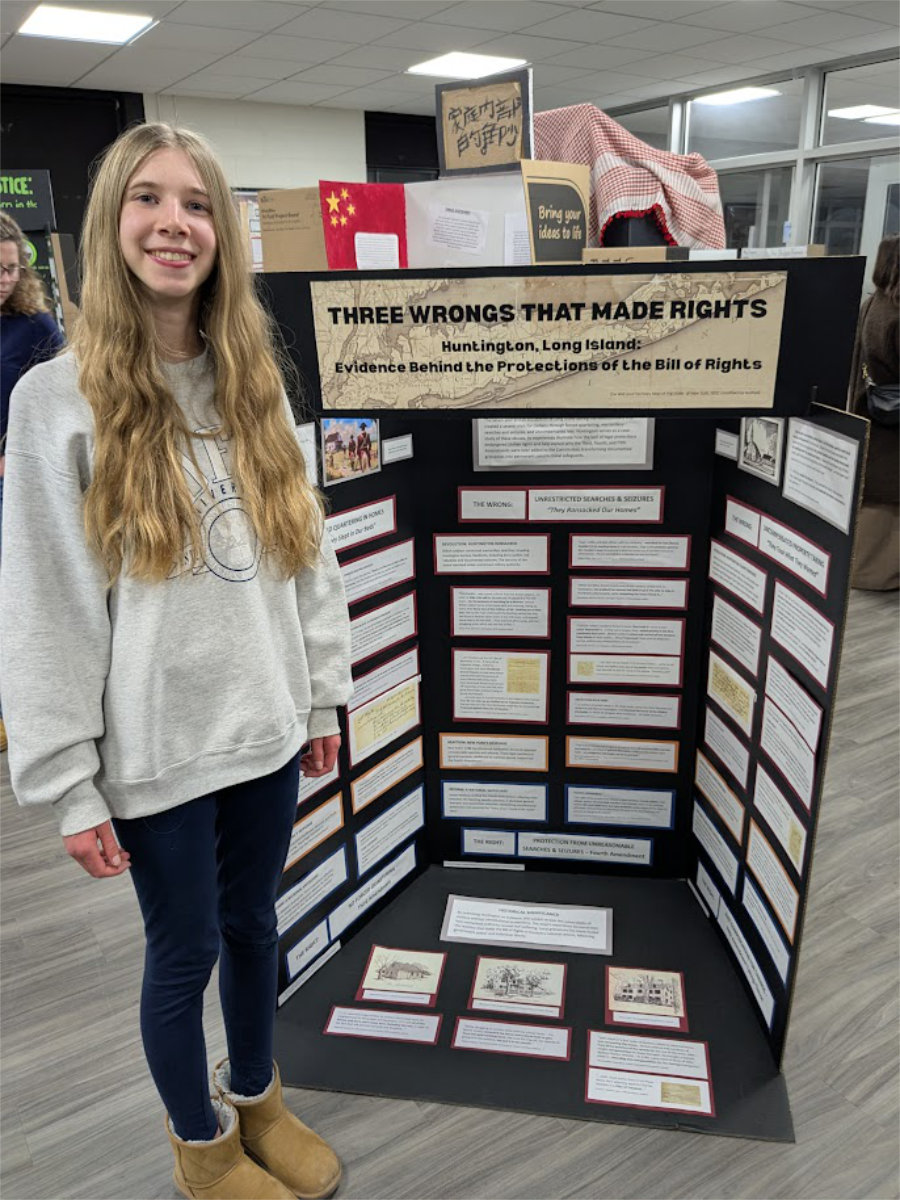
Elena Prior created wonderful thoroughly researched Individual Exhibit category project for this year’s National History Day contest. The Huntington High School freshman titled her work, “Three Wrongs Made Rights [in] Huntington, Long Island: Evidence Behind the Protections of the Bill of Rights.”

Ms. Prior is an academic powerhouse. Her second marking period weighted grade average was a 105. She’s everything you would expect when it comes to being hardworking, insightful, creative, well-read, articulate and creative.
“How timely this in-depth exploration of Huntingtonians’ rights is,” Chairman of Social Studies Joseph Leavy said. “Elena revealed in her research the wrongs done to our ancestors here by the occupying forces of the king, 250 years ago Her work reflects the significance of our community and nation ‘s ongoing struggle to affirm rights for all.”
Ms. Prior spent countless hours on her project, which highlighted the important role Huntington played in the American Revolution and its aftermath.
“I chose to focus my project on a microhistory of Huntington during the Revolutionary War because I am surrounded by reminders of this history,” wrote Ms. Prior in the process paper that accompanied her project. “Living in Huntington, I pass historical sites like Nathan Hale’s Monument, The Arsenal and Washington’s Spy Trail almost every day. Although I had always noticed these sites, this project gave me the opportunity to look beyond the monuments and learn how the war affected the people who lived here.”
The teenager said she started her research by reading through secondary sources on Long Island and Huntington during the American Revolution.
“What stood out most was not battles or espionage, but the hardships civilians faced under occupation,” states the process paper. “Homes were forcibly quartered, property was searched or seized, and food and supplies were taken without compensation by both British forces and Patriot raiding parties. I realized these hardships were more than wartime suffering. They revealed the absence of legal protections that later fueled demands for reform, illustrating the National History Day theme of Revolution, Reaction, and Reform. I used Huntington as a case study to show how Revolutionary abuses led to legal reactions that helped fuel national constitutional reforms.”
Ms. Prior then moved on to primary resources and the files and findings of local institutions. “I examined materials from the Huntington Town Clerk’s archives and ‘Huntington Town Records, including Babylon,’ which documented quartering, property damage, and postwar compensation claims,” according to the process paper. “I visited the Local History Room at the Huntington Public Library, where local history librarian Lori King helped me locate additional sources. I also met with archivist Karen Martin at the Huntington Historical Society and corresponded with Andrew Tharler from Preservation Long Island. These organizations provided pamphlets, artwork, house tour transcripts, and out of print books that deepened my understanding of residents’ experiences.”
Ms. Prior organized her research into three columns that comprise the exhibit. “Each column focuses on a specific wartime abuse experienced in Huntington: forced quartering, unreasonable searches and seizures, and uncompensated property taking,” states the process paper. “The columns follow a parallel structure, with subsections of Revolution, Reaction, and Reform to show how local experiences led to state-level legal responses and ultimately constitutional change. Color coding helps guide viewers through the exhibit: Maroon for Revolution, Orange for Reaction, and Navy for Reform. I displayed sketches of revolutionary-era homes and original manuscripts from the Town Clerk’s office to support the written evidence.”
The freshman said her projects makes the argument that the Third Amendment, Fourth Amendment and Fifth Amendment’s Takings Clause were all shaped in part by real violations of civilian rights during the Revolutionary War.
“Huntington’s experiences show how longstanding colonial grievances intensified under military occupation, allowing military authority to override civil law, leaving residents with little protection,” according to the process paper. “By tracing how residents documented these grievances and how New York State reacted, this exhibit demonstrates how local abuses contributed to national constitutional reforms. This topic is historically significant because it reveals how the Bill of Rights grew out of everyday experiences at the community level. Examining Huntington highlights how constitutional reforms were designed to prevent unchecked power and protect individual liberty—an issue that remains relevant today.”