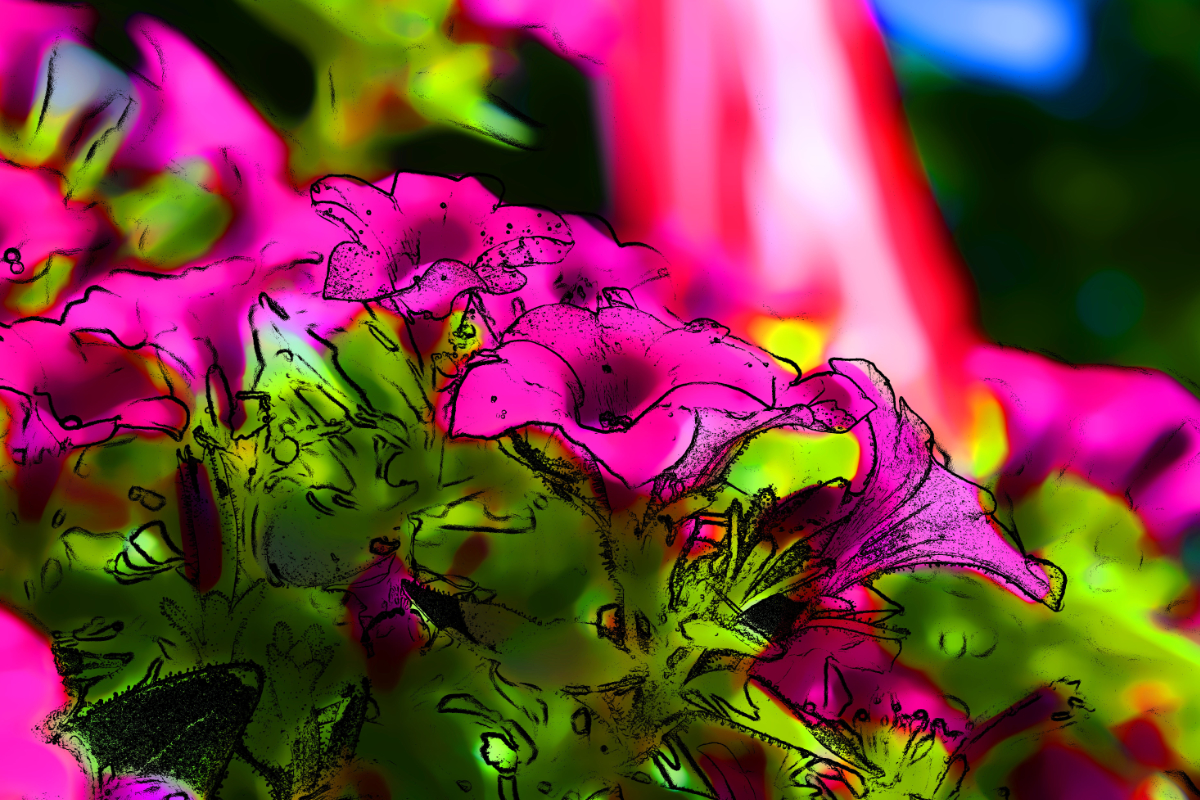
Bringing Fauvism to Photography at Huntington High School
June 4, 2026
Huntington High School photography students recently explored the bold and expressive world of Fauvism, an early twentieth-century art movement known for its vivid colors, emotional intensity, and rejection of realistic representation. Inspired by the groundbreaking work of artists such as Henri Matisse, André Derain, and Maurice de Vlaminck, students transformed their photographs into colorful works of art using Adobe Photoshop.

Fauvism emerged in France in the early 1900s and challenged traditional ideas about color. Rather than depicting the world as it appeared in reality, Fauvist artists used intense, often unrealistic colors to express emotion and create visual impact. Faces could be green, skies could be orange, and shadows could be bright purple. Color became a powerful tool for communication rather than simple observation.
To better understand the movement, students first examined famous Fauvist paintings, paying close attention to the artists' use of color, contrast, and brushwork. They discussed how color choices could influence mood and meaning, and how Fauvist artists prioritized expression over accuracy.
Using their own photographs as a starting point, Huntington students then applied Fauvist principles in Photoshop. Through selective color adjustments, saturation enhancements, gradient maps, digital painting techniques, and creative color overlays, they transformed ordinary portraits and landscapes into vibrant compositions reminiscent of Matisse and his contemporaries. Students experimented with unexpected color combinations and exaggerated hues, learning that artistic expression often requires taking creative risks.
“The project challenged students to think beyond traditional photography,” photography teacher Pamela Piffard said. “Instead of focusing solely on capturing reality, they explored how digital editing can be used as a form of artistic interpretation. By blending photography with the visual language of Fauvism, students gained a deeper appreciation for both historical art movements and contemporary digital tools.”
The final images demonstrate the enduring influence of Fauvism more than a century after its creation. “Through bold colors and imaginative editing, students discovered new ways to communicate ideas, emotions, and personal perspectives,” Ms. Piffard said. “Their work serves as a reminder that art is not always about reproducing what we see—it can also be about expressing how we feel.”
As Henri Matisse once revolutionized painting through his fearless use of color, today's photography students continue that spirit of experimentation, using modern technology to reinterpret a classic artistic movement for a new generation.”