Partners Study Jean-Paul Sartre & the French Existentialist Revolution
February 26, 2026
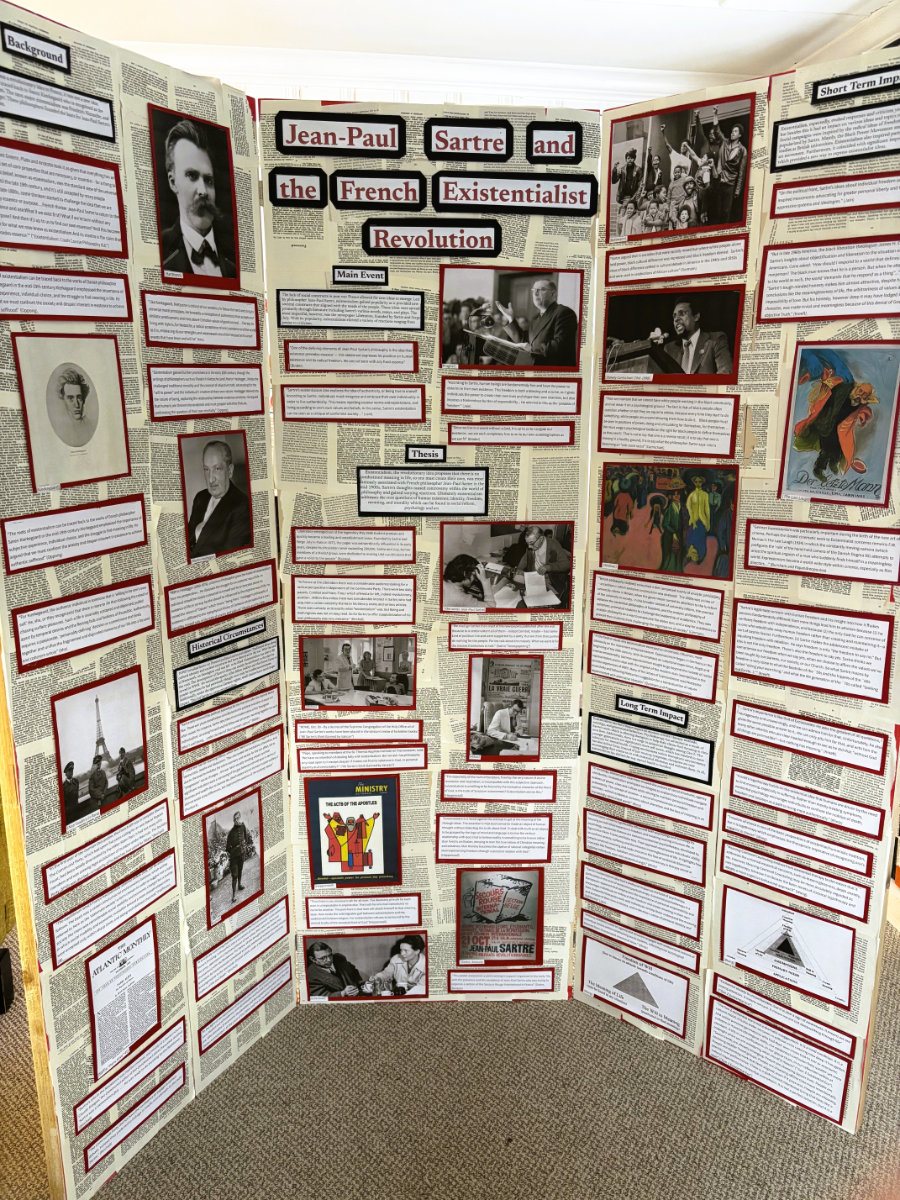
They could have chosen any one of thousands of potential topics, but Sophia Curley and Hennie England never take the easy way out. The two close friends and longtime National History Day research partners developed a Group Exhibit category project titled “Jean-Paul Sartre and the French Existentialist Revolution.” It garnered a Topic of Merit Award and rave reviews from teachers and the department chairman.

“We chose Jean-Paul Sartre as our philosopher to research because of his significant ties to political discussions, which is also something we are greatly passionate about,” states the process paper the partners submitted with their project.
The two sophomores are exceptional students and spectacular young women by any measure. Both teenagers can boast weighted academic grade averages that exceeded 102 in the recent second marking period.
“This project has taught me how to balance challenging courses with the demanding time commitment that National History Day requires,” Ms. Curley said. “I learned how to collaborate even when time doesn’t necessarily work in our favor. And most of all, I learned how to take a disappointing loss with dignity and maturity.”
This year’s National History Day contest showcased students spread across grades 6-12, who submitted exceptional projects in a variety of categories consistent with the 2026 national theme of “Revolution, Reaction, Reform in History.”
“I found it interesting to learn about the real world application of existentialism,” Ms. England said. “I went into the project with an understanding of how existentialism, and philosophy in general, works on a personal level, but I never considered how it can impact large groups of people in a real way. In our project we looked into how existentialism inspired German expressionism in fine art and cinema, education reform, and the black power movement. Sometimes I think philosophy is seen as impractical because it is so abstract, but these movements really demonstrate the importance of studying philosophy and the actual positive effects it can have.”
Students spent months researching and developing their entries and welcomed the attention that was showered upon them during the awards ceremony. Participants entered projects in categories ranging from research papers to individual and group websites, exhibits and documentaries.
“National History Day this year was a huge turning point in my personal growth,” Ms. Curley said. “In contrast to past years, our project didn’t advance to regionals. At first we both were extremely disappointed, but eventually I recognized that loss is necessary to foster growth. Being featured is a win in itself and the loss, though not really a loss anymore in retrospect, was a necessary point in my academic career.”
Teams of teachers served as judges for each category and spent hours evaluating the projects, many of which were displayed prior to the announcement of this year’s award winners.
“I love participating in National History Day,” Ms. England said. “It incited my love for research and I've learned countless skills that are helpful for school. The most useful have been evaluating the credibility of sources, understanding MLA citations, and knowing how to make or read bibliographies. Through doing NHD for several years my research skills have improved tremendously each time.”
The annual history initiative seeks to make history more relevant for students and requires them to use a variety of practical and creative skills during the development of their projects.
Superintendent Beth McCoy, high school Principal Brenden Cusack and Assistant Principal Gamal Smith were all on hand for the recent ceremony honoring the local award recipients.
“I wanted to research existentialism because I knew the basic ideas of the philosophy but I wanted to fully understand it,” Ms. England said. “I read Jean-Paul Sartre's novel ‘Nausea,’ which was helpful in really understanding the themes and ideals of existentialism. Researching the background was particularly interesting because I got to learn about multiple philosophers like Kierkegaard and Nietzsche.”
Among Ms. Curley and Ms. England’s biggest fans is district Chairman of Social Studies, 7-12 Joseph Leavy.
Once again, this year’s National History Day topic development process was learning experience. “I learned a lot of valuable skills from this project,” Ms. Curley said. “In particular, I learned how prominent existentialism is among my generation and how it's making a positive impact. Hennie and I have done National History Day together for four years, and this year we chose a topic we both were truly passionate about so it was super exciting to collaborate with each other.”

The process paper alone is an impressive work of art; well written, articulate and effective in laying out the case for the work engaged in by the Huntington teenagers.
“The meaning of life is a simple question with a complex answer that many people dwell on at least once in their lives,” according to the process paper. “We consistently have philosophical discussions with each other to unpack this question that nobody seems to know the answer to. In our four-plus years of participating in National History Day, we have always wanted to do a project on philosophical thought. We often never agreed on what we believed, which made narrowing down a topic very difficult in the past. Recently though, we both came to an agreement that existentialism is something we both deeply resonate with. And while this is a philosophical idea and not a fixed event, it has made an extremely notable impact on society and can be considered a revolutionary idea that came with mixed reactions. With such a personal connection to this, we knew that existentialism was the perfect focus for our project.”
The exhibit, complete with the research that went into it is on display in the northwest corner of the high school’s second floor. “The display can be viewed by all and with a reading of some quotes and the girls’ analysis, students and teachers alike can add to their understanding of existentialism; it’s well worth it,” Mr. Leavy said.
“We started our research by gaining background information on who Jean-Paul Sartre is,” states the process paper. “We studied the main principles of his philosophy by reading transcripts of Sartre’s interviews. This provided an insightful look into how his mind operated and the main components of his philosophy. Sartre was active at an extremely influential time, with World War II happening at the time of his most memorable work. Then we looked at how Sartre popularized existentialism. We studied his newspaper, Libération, as well as some of his plays and influential works. We looked at the reactions to his ideas, which varied greatly. Some people found the idea comforting, while others found it repulsive. The most notable finding was the banning of Sartre's work in the Vatican. To finish up our research, we looked at how the modern world is impacted by existentialism. Gen Z in particular is applying existential ideals to their lives and is shaping the way they view the world.”
The partners said after concluding their research, they started to build the exhibit. “We gathered pages from old books from our local library and used that as the backdrop,” states the process paper. “Then we chose red and black as our background paper, then we printed our text and images out and stapled it to our exhibit.”
The teenagers ably answered the proverbial question of how their project tied into this year’s National History Day theme of “Revolution, Reaction, Reform in History.”
“Jean-Paul Sartre's impact on existentialism is important to history because it aided the thought and meaning crises that many experienced after World War II,” according to the process paper. “It provided a new perspective for those that didn’t find comfort in religion and it emphasized an individual experience to life. It also shaped the way psychology developed. Existentialism provides a framework through which individuals can view their life in circumstances that seem random and unforgiving. The philosophy also influences many artists who created art based on the ideas of existentialism.”