
Duck Nursery at Jefferson
Primary School
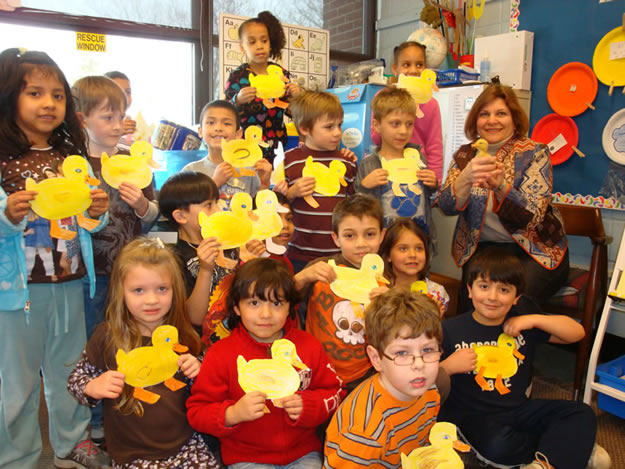
Huntington Hospital isn't the only facility in touch with a nursery for newborn babies. Jefferson Primary School on Oakwood Road was nursing 18 baby ducks one recent day as students there were busy learning about life cycles.
The Jefferson youngsters are first graders in classes taught by Carol Coffey, Theresa Duffy, Kathy Kraus, Marianna Irigoyen and Tricia Martin. Each class was given six duck eggs and an incubator as part of a program to teach students the intricacies of hatching the eggs into baby ducks.
 In order to properly care for the eggs, students had to learn and understand a variety of bits and pieces of information. For example, the incubators had to stay hydrated by adding water; students had to monitor the temperature making sure it remained at 100 degrees and the eggs had to be rotated.
After about four days, one of the eggs started to wiggle and crack. This was big news on the first grade level. A short time later, a small beak started to appear out of the egg. An incubator malfunction in one class prevented six of the eggs from hatching, but the other three classes were happy to share their ducks.
During library classes, Jefferson library media specialist Cindy Tietjen taught the first graders about the 'egg tooth' that ducks utilize to break the shell of the egg during the hatching process. It wasn't long before a dozen baby ducklings were being nursed at the school. Even more followed.
 The youngsters made sure the baby ducks stayed in the incubator for 24 hours after they were hatched. They were then moved into their Rubbermaid home, which is warmed by a heat lamp and furnished with hay, water and food.
The ducks in Mrs. Coffey's class went for their first supervised swim about a week after they hatched. They seemed to relish splashing in their Rubbermaid pond, conveniently located in the classroom.
"We knew an egg was about to hatch because we first noticed a tiny pimple or bubble on the egg and then a crack," Mrs. Coffey said. "The egg was moving - kind of rocking back and forth. After a few hours, the egg was really moving and there was a hole about the size of a dime in the egg and we could see the bill! Within a half hour after that, the duckling was completely out of the egg and exhausted - just sleeping - and looking a bit wet and slimy. We put a bit of water in the incubator and within a couple of hours the ducklings were drinking."
 Students also learned how the baby ducks find each other by echolocation. The ducks were spread out all over the classroom and as the children watched and heard them chirp and listen, they were amazed at how quickly they all gathered together for a group hug. "So cute, the kids loved it," Mrs. Coffey said.
The supervised swims were always popular. Six ducks were put in the Rubbermaid container at a time. 'The saying 'likes ducks to water' took on a whole new meaning," Mrs. Coffey said. "They swam, paddled, dipped under, and washed off. Then, like the little babies they were, they fell fast asleep under the warming lamp in their container."
The duck eggs arrived on Tuesday and by Friday they were walking around the room. The following Thursday they were on their way back to the duck farm, all dry and fluffy.
"It was a great experience for the kids," Mrs. Coffey said. "They were fascinated watching the eggs hatch and delighted with the ducklings. It isn't often that kids can get so close to nature and witness part of the life cycle process. I think this is a memory they will keep for some time."